Local Spotlight
9 min read
The Paul W. Bryant Museum: Alabama Football's Front Room
Five dollars, about an hour, and open six days a week: the Bryant Museum is the deepest football stop in Tuscaloosa that isn't the stadium itself. What's inside, what it costs, and how to fit it into a campus morning.
Edited by Ramada by Wyndham Tuscaloosa Editorial Team
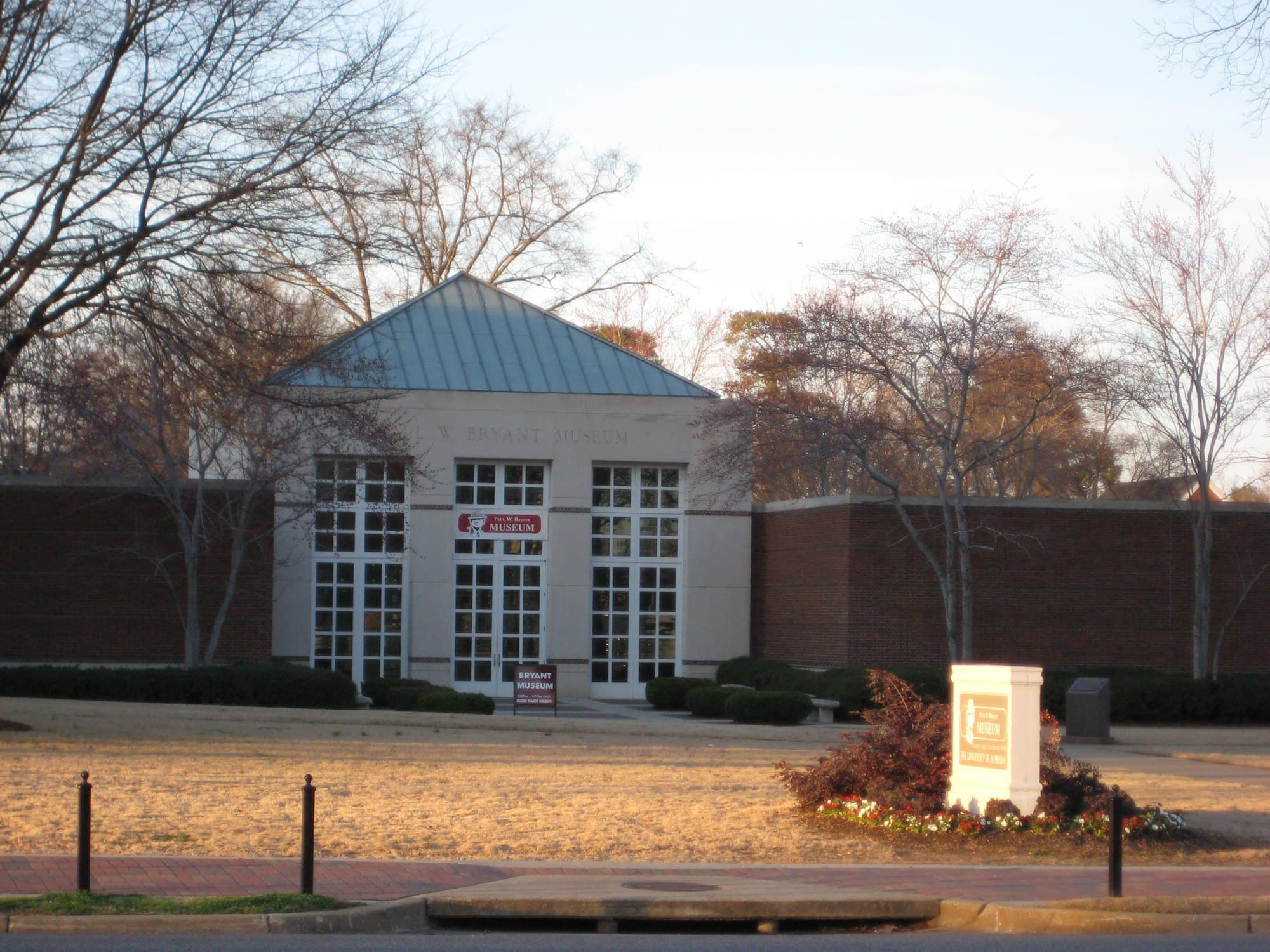
Photo by Rtr10 on Wikimedia Commons · Public domain
Most football trips to Tuscaloosa point at one building. Bryant-Denny seats more than a hundred thousand people and it is the reason a lot of guests book a room here between September and November.
The Paul W. Bryant Museum sits on the same street, and it is the stop people skip and then wish they hadn't. Five dollars. About an hour. Open six days a week whether or not there is a game. The stadium is where Alabama football happens. The museum is the front room, the place where the program keeps the things it decided were worth holding onto.
The reason it gets skipped is easy enough to name. Visitors assume the stadium covers the subject, and that a museum down the street from it must be the gift shop version of the same story. That gets it backwards. An empty stadium tells you how big the thing is. The museum tells you how it got that way, which is the harder and better question.
What's actually in there
The museum tells the story of Alabama football, and it does it with objects rather than a highlight reel. Bear Bryant's office has been recreated inside. His houndstooth hat is here. The artifacts run from Joe Namath and Ken Stabler forward through every era since, up to the current one.
A recreated office is a strange thing to build a museum around, and it is the part visitors tend to describe first when they get back to the car. A trophy case tells you a program won. A room tells you about a person: how much space he worked in, what a day in that job looked like before any of it hardened into myth. Two minutes would cover it. People give it longer.
The hat does similar work. It is a piece of felt that became shorthand for an entire state's relationship to a sport, which is a lot of freight for a hat to carry, and seeing the actual object is a decent corrective to the size of the legend.
Give the whole place an hour. That is the honest number for a normal visitor moving at a normal pace. If you grew up on this program you will take longer, and if you have a seven-year-old you may take less.
Who this is for, and who it isn't
The obvious audience is the fan, and the fan does not need convincing. The more interesting case is everyone else.
If you are in town for a campus tour with a high schooler, the museum is a cheap, contained hour that explains a big piece of what your kid is about to live inside for four years. Alabama football is not a side interest on that campus. It shapes the fall calendar, the traffic, the hotel rates, the mood on a Sunday morning. An hour here is context.
If you are a business traveler with a dead afternoon, it beats the alternatives on Skyland Boulevard, and it costs less than a sandwich.
Then there is the returning alum, who is really the reason a museum like this exists. Anyone who spent four years here has a decade of the program filed somewhere in memory, usually the decade they were enrolled for. What the museum does is put that decade next to all the others, which tends to be humbling in one direction or the other depending on which years you got. Bring the person who keeps telling the same three stories. Let the exhibits either back them up or quietly correct them.
If you are traveling with kids, $3 for K–12 and free under 5 makes it one of the lowest-stakes stops in town. An hour is short enough that you are back outside before anyone asks to be, and $3 is little enough that leaving early costs you nothing.
And if you have no interest in football at all? Be honest with yourself. This is a single-subject museum about one program at one university, and it is a good one, but an hour is still an hour and nobody should feel obligated. The Alabama Museum of Natural History on the Quad and the Riverwalk downtown are both a few minutes away and ask nothing of you football-wise, and our things to do page lays out the non-football side of Tuscaloosa.
Hours, admission, and the parts we won't guess at
Address is 300 Paul W. Bryant Drive, on the University of Alabama campus near the stadium. Phone is (205) 348-4668. The site is bryantmuseum.com.
Admission is $5 for adults and $3 for K–12. Under 5 is free, and University of Alabama students, faculty, and staff get in free. The museum operates Tuesday through Sunday, so Monday is the day that catches people out.
Here is what we are not going to tell you: the exact opening and closing times. We could not confirm the current daily hours from a source we trust, and a spotlight post that invents a closing time is worse than useless when you have driven over with forty minutes to spare. Call the number above or check the site the morning you plan to go. Same answer for home-game Saturdays. Hours at campus attractions can move around when a hundred thousand people are coming to town, and we would rather say so plainly than publish a schedule that falls apart on the one weekend you needed it.
While you have someone on the phone, ask about parking. Campus lot rules in Tuscaloosa vary by day, by season, and by whatever is happening on the Quad that week, and the museum's own staff will give you a better answer than we can.
The stadium tour is the natural pairing
Bryant-Denny runs public tours on weekday mornings, $30 per person, booked in advance, through the locker room, the press box, and out onto the field. If you can line up a weekday morning, tour first and museum second is a good order. The tour puts you inside the building. The museum explains why the building matters.
The price gap between them says something useful about how to plan. Thirty dollars buys you scale and access. Five dollars buys you the archive. They are not competing for the same slot, and doing both in one morning is maybe two and a half hours plus the walk between them. That is a legitimate half day for $35 a head, which in the world of destination sports tourism is close to a rounding error.
If you only have room for one, pick by temperament. People who want to stand somewhere significant should take the tour. People who want to understand something should take the museum.
The weekday-morning restriction on the tour matters more than it looks. A lot of visitors are here Friday through Sunday, which puts the stadium tour out of reach entirely unless the Friday morning works. The museum's Tuesday-through-Sunday schedule covers most of a weekend trip, and that alone makes it the more reliable of the two to plan around. Book the tour if your dates allow it. Do not build the trip on it.
Building a campus half day around it
The museum sits close enough to the rest of campus that you can chain a few things together without moving the car much.
The Quad is the obvious anchor: a large, handsome green at the center of campus, with Denny Chimes standing on it. A walk across is free and takes as long as you want it to. Gorgas House Museum is right there, $2 to get in, open Tuesday through Saturday, built in 1829 and one of the few buildings that survived the burning of the university in 1865. It is a twenty-minute stop, not an hour.
The Alabama Museum of Natural History in Smith Hall runs $5 for adults and $3 for K–12, the same as the Bryant Museum, and it holds the Hodges meteorite, the only meteorite in recorded history confirmed to have hit a person. One note that matters for planning: it closes on Alabama home-game Saturdays.
A workable sequence for a non-game weekday: Bryant Museum when it opens, walk the Quad, Gorgas House, then either Smith Hall or lunch, depending on how the group is holding up. Our things to do near the University of Alabama post covers each of these in more detail if you want to build a longer version.
Sunday is the day that half day partly falls apart, and it is worth knowing before you plan around it. Gorgas House runs Tuesday through Saturday, so it is out. The Bryant Museum is not, since its week runs Tuesday through Sunday. If Sunday is the only campus day your trip has, the museum plus a Quad walk is a real morning on its own, and you have not lost much. Monday is the genuinely thin day. The Bryant Museum and Gorgas House are both closed, which leaves you walking the campus and the Riverwalk. Not nothing. Not what you came for either.
Getting there from Skyland Boulevard
From the hotel at 631 Skyland Blvd East, the museum is about 3.6 miles and roughly 8 minutes, a straight shot up McFarland toward campus. That is the drive without game-day traffic on it.
On a home Saturday, throw that number out. Campus and the streets feeding it slow to a crawl for hours on either side of kickoff, and the walk from wherever you end up parking is part of the deal. If a museum visit is on your list for a football weekend, do it Friday or Sunday and save yourself the aggravation. Our game-day weekend itinerary works through how those Saturdays actually run.
This stretch of Tuscaloosa is car-first. There is no version of this trip where you walk from Skyland Boulevard to campus, and we are not going to pretend otherwise. What you get instead is an easy highway location, free parking and a continental breakfast in the morning, and a short drive to everything on this page. For where to eat before or after, our dining guide has the barbecue, the Southern diners, and the rest of what is close.
One thing worth stating plainly: we are an independently operated Ramada franchise on Skyland Boulevard, with no affiliation with the University of Alabama. Nothing here is official University guidance. We are just the hotel down the road that sends a lot of guests to this museum and hears back about it.
Planning a Tuscaloosa trip? Check availability and book a room on Skyland Boulevard.
FAQ
Common questions.
How much does the Paul W. Bryant Museum cost?
Admission is $5 for adults and $3 for K–12 students. Children under 5 get in free, and University of Alabama students, faculty, and staff are free.
Is the Paul W. Bryant Museum open on Mondays?
No. The museum operates Tuesday through Sunday and is closed Mondays. We were not able to confirm current opening and closing times, so check bryantmuseum.com or call (205) 348-4668 before you drive over.
How long does it take to go through the Bryant Museum?
About an hour for most visitors. Budget longer if you read every panel or you came specifically for one era of the program.
How far is the Paul W. Bryant Museum from Skyland Boulevard?
About 3.6 miles from the Ramada by Wyndham Tuscaloosa at 631 Skyland Blvd East, which is roughly an 8-minute drive without game-day traffic. The museum address is 300 Paul W. Bryant Drive.
Can you visit the Bryant Museum on an Alabama home-game Saturday?
The museum's regular schedule includes Saturdays, but hours at campus attractions can shift on home-game weekends and the whole area gets busy. Call (205) 348-4668 to confirm before you build a game-day plan around it.
Planning a trip to Tuscaloosa?
We’re on Skyland Boulevard, four miles from downtown and the University of Alabama — free parking and a free continental breakfast every morning.
Check Availability