Local Spotlight
8 min read
Moundville Archaeological Park: Alabama's Ancient City
Fifteen miles south of Skyland Boulevard. It has 185 acres, 29 earthen mounds and the Jones Archaeological Museum. What the park is, what it costs, and how to plan the half day.
Edited by Ramada by Wyndham Tuscaloosa Editorial Team
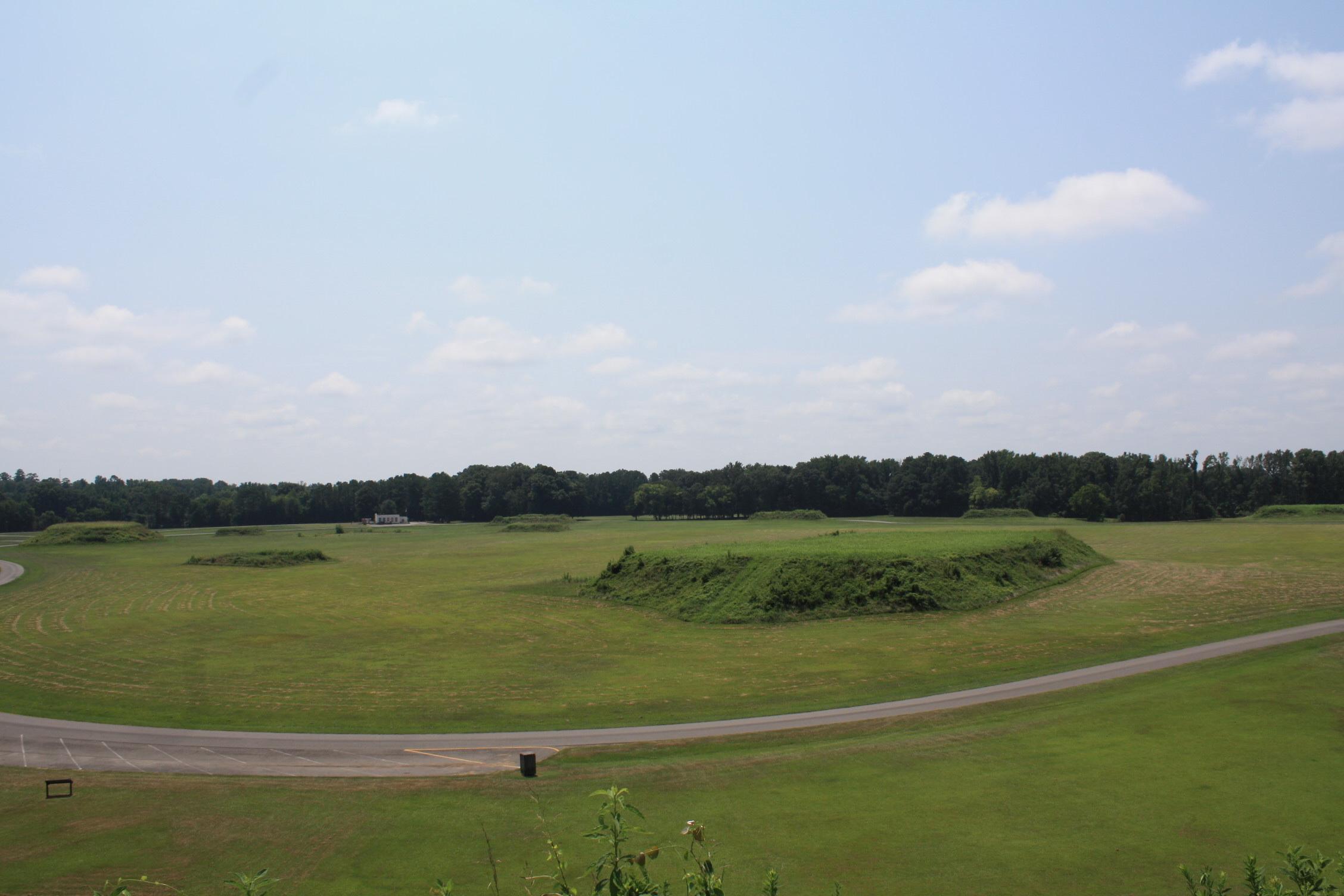
Photo by Altairisfar (Jeffrey Reed) on Wikimedia Commons · CC BY-SA 3.0
Almost everything a visitor does in Tuscaloosa sits inside about four miles of Bryant-Denny Stadium. The campus museums, the barbecue, the Riverwalk, the stadium itself. It's a compact town that way, and most trips here never need a drive longer than ten minutes.
Moundville is the exception, and it's the one worth breaking the pattern for. About fifteen miles south of the hotel, on the Black Warrior River in Hale County, 185 acres of mowed ground hold 29 earthen platform mounds arranged around a central plaza. They were built by hand, basket of soil by basket of soil, by people living on that bend in the river long before anything else on the local map had a name.
It isn't a football story and it isn't a campus story. That's most of the reason we keep pointing guests toward it.
What it is
Moundville Archaeological Park is operated by University of Alabama Museums. That's the same outfit behind the Alabama Museum of Natural History over on campus. The park covers 185 acres along the river, with 29 platform mounds still standing on it and the Jones Archaeological Museum on the grounds.
The people who built it belonged to what archaeologists call the Mississippian culture. The site is routinely described as one of the largest Mississippian centers in the country. The Jones museum tells the rest of the story with objects that came out of the ground right there. Half an hour inside will frame what you're looking at better than any paragraph here.
The thing to understand before you arrive is the shape of it. This was a planned town. The mounds aren't scattered across the acreage at random: they sit around a broad open plaza in an arrangement somebody decided on. That detail changes how the place reads once you're standing in the middle of it. You aren't looking at hills. You're looking at architecture.
Why it's worth the drive
The scale gets people first, and it's a quiet kind of scale. Nothing announces itself from the parking lot. You walk out onto open ground, the plaza opens up, and the mounds resolve slowly into something deliberate. Visitors who came expecting a historical marker and a plaque tend to stop talking for a minute.
Then there's the simple fact that it's unlike anything else within an hour of here. We've written up the other day trips worth making from Tuscaloosa, but they're museums, a city, a river town. Moundville is the only one where what you came to see was built before all of that and is still sitting where it was put.
The practical case matters more than it sounds. It's cheap, it's close, and it works on a day when the rest of the town doesn't. The Jones museum runs seven days a week, which the Alabama Museum of Natural History, closed on Sundays, does not. If Sunday is the only free day your trip has, a campus-museum plan gets thin and Moundville is open.
Who gets the most out of it
Anyone with a general curiosity about the place they're standing in will do fine here. Beyond that, a few groups get noticeably more out of the drive than others.
Families with school-age and older kids, first. A lot of American kids cover Mississippian cultures at some point in school, in the abstract, from a textbook. Standing on a mound they read about does something a worksheet can't. Be realistic about small children, though. This is open ground and a lot of walking, with limited shade and not much to touch, which is a different proposition from a playground afternoon.
Second, anyone in town for a campus visit with a spare morning. A university tour tells you what the next four years look like. Moundville tells you what was on this stretch of river long before the university existed, which is a strange and useful piece of context to carry around.
And third, the repeat visitor who has already done the football circuit. If you've been to Tuscaloosa three times for games and seen the stadium, the Bryant Museum and the inside of Dreamland, this is the obvious thing you haven't done.
Hours and admission
Check the park's current hours on its official website before you drive down. The grounds, the Jones Archaeological Museum and the admissions office each keep their own hours. Look them up the morning you go, not the week before.
Admission is $8 for adults, $7 for seniors, $6 for students and $6 for military.
If you're bringing children, check the park's official website for their rate.
The one planning rule that holds whatever the posted times are: don't arrive late in the day. The admissions desk is where the visit starts, and turning up near the end of the afternoon to find it already shut is a specific kind of wasted drive. Leave yourself the better part of a morning or an afternoon on site.
The simplest answer is to go in the morning. An early start gets you the open ground in cooler air and better light, with the museum still ahead of you when the sun gets high.
Tips worth knowing
Museum first on a first visit. The instinct is to head straight out to the mounds, because the view is right there and nobody drove fifteen miles to read panels. Go inside first anyway. The museum is what lets you look at an earthwork and understand what it was for, and that's the whole difference between a nice walk and an actual visit.
It's an open site. Shade is limited on a mowed plaza, and Alabama summers are not mild. Hat, water, sunscreen. Between late spring and early fall, aim for the morning or the last couple of hours before the grounds close rather than the middle of the afternoon. Spring and fall are the comfortable seasons for this one, which happens to be when most people are in town anyway.
Wear something you can walk in. Grass and uneven ground, and soft going for a day or two after rain.
Give it half a day. The museum plus the grounds at a normal pace is a morning or an afternoon, not a quick stop. Read every panel and walk the whole site and it runs longer.
Eat on either end of the trip. Have a meal before you drive down or after you're back. Our dining page has what's close to the hotel, by style and distance.
What pairs with it
Moundville is a half day, which leaves the other half to fill.
The natural pairing is thematic rather than geographic. The Alabama Museum of Natural History in Smith Hall is run by the same University of Alabama Museums. It is open Monday through Saturday, 10 AM to 4:30 PM, closed Sundays. It's on the far side of town from Moundville, so don't try to chain the two into one afternoon. Put them on consecutive days and the connection between the collections is easier to see anyway.
While you're at either admissions desk, ask about the multi-attraction pass. It covers the natural history museum, the Gorgas House Museum and Moundville on a single ticket.
If the Moundville morning ends early, the Tuscaloosa Riverwalk runs along the same river closer to town, costs nothing, and asks nothing of you. The full non-football version of a weekend here, with a Moundville half day as the optional middle of it, is laid out in 48 hours in Tuscaloosa without a game. The things to do page covers the rest of what's inside a short drive.
One piece of timing that locals use without thinking about it: a home-game Saturday is an excellent day to leave town. The roads heading away from Tuscaloosa are clear in the morning while everyone else is pointed at campus. You come back in after the traffic has sorted itself out.
Getting there from Skyland Boulevard
From the hotel at 631 Skyland Blvd East, the park is about fifteen miles south, roughly a 24-minute drive without anything unusual on the roads. The address is 634 Mound State Parkway.
This is a drive. There's no transit version of this trip, and no walking version, and we're not going to dress that up. It's true of most of Tuscaloosa and it's especially true of a park in the next county. What this side of town gets you instead is a fast exit south, free parking and a free continental breakfast before you go, and barbecue close by when you get back: the original 1958 Dreamland is 1.3 miles from the front door, and we've written the full history of it.
Worth stating plainly: we're an independently operated Ramada franchise on Skyland Boulevard. We have no affiliation with the University of Alabama or its museums. Nothing here is official park guidance. We're the hotel up the road that sends people down there and hears back about it, and the park's own number, (205) 371-8732, beats us on anything that might have changed this week.
Planning a trip around it? Check availability and book a room on Skyland Boulevard.
FAQ
Common questions.
How far is Moundville Archaeological Park from the hotel on Skyland Boulevard?
About fifteen miles south of 631 Skyland Blvd East, which is roughly a 24-minute drive on a normal day. The park sits on the Black Warrior River in Hale County at 634 Mound State Parkway.
What are Moundville Archaeological Park's hours?
Check the park's current hours on its official website before you go. The grounds, the Jones Archaeological Museum and the admissions office each keep their own hours. Trust the park's own listing over any figure repeated elsewhere.
How much is admission to Moundville Archaeological Park?
$8 for adults, $7 for seniors, $6 for students and $6 for military. Check the park's official website for a children's rate if you're bringing kids.
How long do you need at Moundville Archaeological Park?
Half a day covers the Jones Archaeological Museum plus the grounds at a comfortable pace. If you're passing through and only want the museum, an hour is enough.
Planning a trip to Tuscaloosa?
We’re on Skyland Boulevard, four miles from downtown and the University of Alabama — free parking and a free continental breakfast every morning.
Check AvailabilityKeep reading

Local Spotlight
8 min read
The Mercedes-Benz Amphitheater: Tuscaloosa's Riverfront Stage
The city-owned amphitheater on the Black Warrior River, formerly the Tuscaloosa Amphitheater. What it is, how it is laid out, and what gets staged there.
Read More
Local Spotlight
8 min read
The Paul W. Bryant Museum: Alabama Football's Front Room
Five dollars, about an hour, and open six days a week: the Bryant Museum is the deepest football stop in Tuscaloosa that isn't the stadium itself. What's inside, what it costs, and how to fit it into a campus morning.
Read MoreListicle
8 min read
Indoor Things to Do in Tuscaloosa on a Rainy or Cold Day
Eight indoor options within about fifteen minutes of Skyland Boulevard, with hours and prices.
Read More